


On Thursday, October 28, 2012, in a 5-4 decision, the United States Supreme Court upheld the constitutionality of the Obama’s Administration’s universal healthcare coverage legislation, also know as Obamacare. The law will make it illegal for insurance companies to decline coverage for individuals with pre-existing conditions. The full power of the legislation will not be enforced as law until 2014.
According to estimates based on data collected in 2010, approximately 49.9 million Americans are living in the United States without health insurance. In March of 2012, Mandelbrot Law Firm – The Asbestos Legal Center, a law firm representing mesothelioma patients and victims of asbestos related disease, estimated based upon the mesothelioma incidence rate for the general population, that as many as 16% of patients diagnosed with mesothelioma don’t have health insurance.
The Obamacare ruling on it’s face, seems to suggest that patients suffering from Mesothelioma and asbestos related disease who don’t possess health care coverage, should be able to purchase medical insurance to cover their healthcare needs after diagnosis. As malignant pleural mesothelioma is a disease typically associated with a nine month survival rate and costly medical treatments, including surgery, radiation, and chemotherapy, the ruling appears to be gigantic step towards extending the life of uninsured patients. But unfortunately patients have to wait until 2014 to get this help.
Until the law goes into effect in 2014, there are still options Mesothelioma patients without healthcare coverage can pursue, to pay their medical bills.
Veterans of the United States military suffering from asbestos related diseases should go to their local Veterans Administration Hospital, and pursue coverage through the Veterans Administration. Unfortunately, many of our service men and women were exposed to asbestos onboard U.S. Navy ships, and during their military service.

Another option mesothelioma patients without healthcare coverage can choose to obtain medical assistance, is to volunteer to participate in clinical trials. Given that the malignant pleural mesothelioma incidence rate is low in the general population, researchers have difficulty finding patients to work with to test new procedures and drug regimens. Often times there will be funding available to pay for travel related expenses and the medical care associated with the clinical trial. Mesothelioma patients without health care coverage should contact their local hospital and ask for information about clinical trials. There are always risks associated with clinical trials. That being said, many clinical trials for mesothelioma patients often have gone on for great lengths of time, and prior to entering a clinical trial a patient can ask for safety and efficacy data the trial has collected.
Still another option that mesothelioma patients can pursue to obtain funds to cover their medical bills, is to seek compensation in the tort system and bankruptcy courts.
Malignant pleural mesothelioma is considered a signature disease, meaning that is only has one cause, exposure to asbestos. Millions of dollars have been set aside in bankruptcy trusts, for individuals exposed to asbestos contained in the products of bankrupt companies. Moreover, individuals can file lawsuits against companies that are still in business, who caused their injuries. Patients diagnosed with mesothelioma should Continue reading




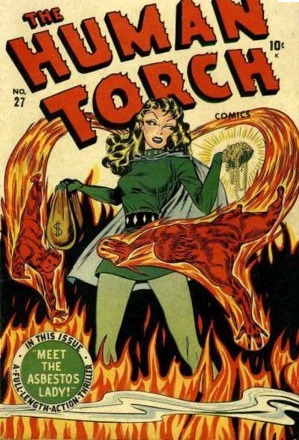
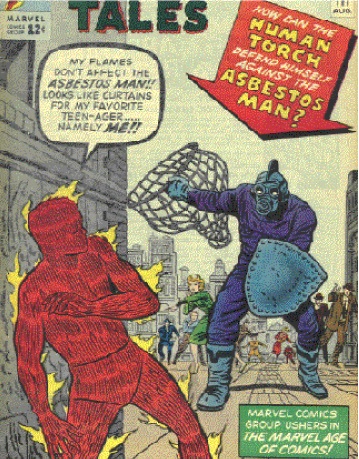 Torch, hoping to gain notoriety and respect from the criminal underworld. His arsenal of weapons included and net he would throw at the Human Torch, that would covert heat to explosive charges. His criminal master plot was very similar to Asbestos Lady: he robbed banks after creating infernos surrounding them. In their first encounter Asbestos Man actually defeated the Human Torch, but he was eventually captured when The Human Torch created a fire so large, that all of the oxygen in a bank disappeared, making it impossible for Asbestos Man to breathe.
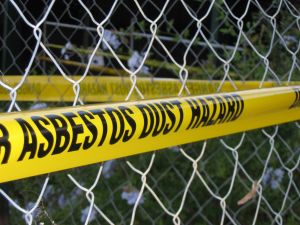 Every weekend in San Diego County, California, throngs of United States residents travel south across the border to Mexico, looking for bargains in Tijuana shopping malls. As the weekend ends, the line of cars coming back into the United States extends for miles. In 2005, 50 million people, and 17 million vehicles, traveled from Mexico, across the U.S. Border, into San Ysidro, California. There, U.S. Customs agents are tasked with trying to organize the mass exodus while at the same time protecting America from illicit drugs, human trafficking and terror threats. But recent reports from Mexico highlight a growing concern among public health and consumer safety advocates, that there is one menace that U.S. Customs agents are ill equipped to control. Consumers may be returning home to United States with products purchased in Mexico, that unbeknownst to them, contain a destructive poison indistinguishable to the naked eye, asbestos.
 However, in the past non-profit organizations have found asbestos contaminating common consumer products such as children fingerprint dusting kits, in talcum powders, toy clays kits, hair rollers, hot plates, hair dryers and decorative floor tiles. Moreover, asbestos contaminated vermiculite, sometimes used as a packing material for products, is also a public health concern.